How to Measure a Gift Box: Inside Sizes in mm
Every box we make is built around an inside size in millimetres, written as length × width × height. Get those three numbers right and the rest of the order is simple.
By The Gift Boxes design team ·
Why do we ask for the inside size?
The inside size is the space your product actually has. The outside of a box is always larger, because the board and any wrap paper add to each wall.
On a folding card box the difference is small. On a rigid box, the greyboard and its paper wrap add more, and a lid and base box adds again, as the lid fits over the base.
If you give us the outside size by mistake, the product will not fit. So measure the item, add a little room, and send that as the inside size. We work out the outside from there.
The inside size also decides how your artwork is laid out. Panels, fold lines and the lid edge are all drawn from it, so a change to the size after proofing means a fresh layout.
What do length, width and height mean on a box?
Length is the longer side of the box opening, seen from above. Width is the shorter side of the opening. Height is the depth from the floor of the box to the underside of the lid.
Always give them in that order: L × W × H. A box of 220 × 160 × 80 is 220 mm long, 160 mm wide and 80 mm deep inside.
For a drawer box, think of the tray. Length runs in the direction the tray slides, and height is the depth of the tray.
For a book style box, the cover opens like a book, so length runs along the spine. For a gable box, height is measured to the base of the handle, not to its top.
- Length: the long side of the opening
- Width: the short side of the opening
- Height: floor to the underside of the lid
- Units: millimetres only, not centimetres or inches
How do I measure my product step by step?
You need a steel rule or a tape measure marked in millimetres, a flat table and the product as it will be packed. Measure the real item, not the size on a supplier spec sheet.
- Put the product on a flat surface in the position it will sit in the box.
- Measure the longest side at its widest point, including caps, pumps, handles or bows.
- Turn and measure the shorter side across the widest point.
- Measure the height from the table to the highest point, again including any lid or pump.
- If several items go in together, lay them out as they will be packed and measure the whole group.
- Write each figure down in millimetres and round up to the next whole millimetre.
- Measure a second unit, as handmade and filled products often vary by a few millimetres.
Use the largest figures you record. A box sized to the smallest unit in a batch will not close on the biggest one.
How much room should I leave around the product?
For a snug fit with no insert, add about 2–3 mm to the length and the width. That lets the item drop in and lift out without scraping the walls.
Add a little more to the height, about 3–5 mm, so the lid closes without pressing on the product. A domed candle lid or a pump top needs the extra most.
For soft goods such as clothing, the item squashes, so you can size closer. For glass or ceramics, leave more room and fill it with an insert or shred.
Hampers need their own check. Lay any bottle on its side if it will travel that way, and size the length to the bottle plus its neck. Then build the other items around it, rather than sizing to the jars and finding the bottle will not fit.
Too much room is as bad as too little. A product that slides around will knock the walls in transit and can chip or scuff, so fill any gap over about 10 mm with tissue, shred or an insert.
How do tissue, shred and inserts change the size?
Anything that goes in with the product takes up space. Tissue wrapped around a folded item adds a few millimetres on every side. Shred or crinkle paper needs real depth to do its job.
An insert changes the sum completely. Here you measure the product to size the insert, and the insert sets the inside size of the box. Tell us the product sizes and we plan the insert and box together.
Our guide to card, foam and pulp inserts explains how each type adds to the box size.
What size box fits common gift items?
The sizes below are common starting points, not stock sizes. Use them to sense-check your own measurements, then send the size your item really needs.
| Item | Box style | A common starting size (mm) |
|---|---|---|
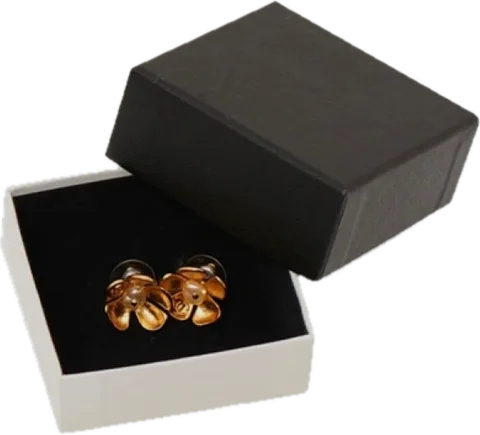
| Ring | Jewellery box | about 60 × 60 × 40 |
| Necklace laid flat | Jewellery box | about 120 × 120 × 35 |
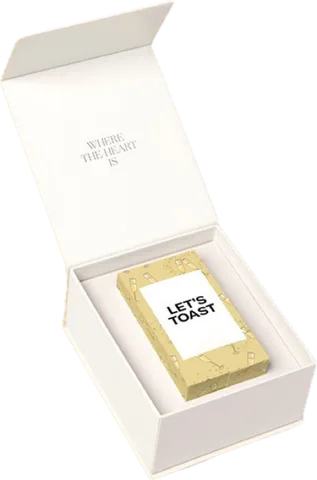
| Gift card | Gift card box | about 95 × 65 × 15 |
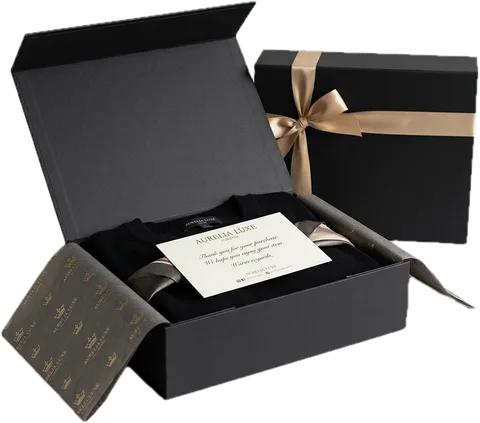
| Folded shirt | Clothing box | about 330 × 250 × 70 |
| Folded knitwear | Clothing box | about 350 × 280 × 100 |
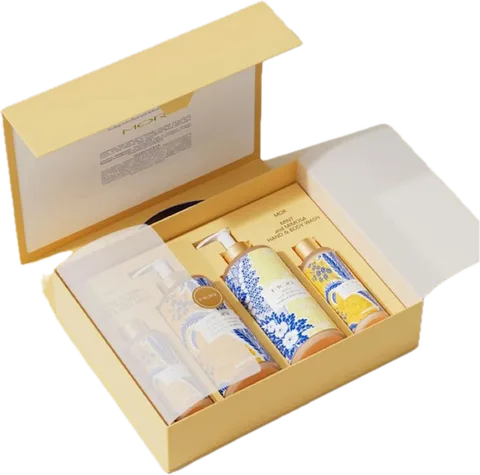
| Skincare set | Magnetic lid box | about 220 × 160 × 80 |
| Small food hamper | Hamper box | about 320 × 250 × 120 |
More starting sizes for every style are listed on our gift box sizes page.
How do I measure clothing for a gift box?
Fold the garment exactly as it will be packed, with any tissue or a card backer in place. Press it down lightly with a flat hand and measure the folded stack.
Measure height while the garment is pressed, then add about 10 mm. Knitwear springs back more than a shirt, so allow extra for chunky jumpers.
If you sell several sizes, measure the largest size folded. One box that suits small to large is easier to stock than three. Typical starting sizes are on our clothing gift boxes page.
How do I measure for small items like jewellery?
Small items are usually held by an insert, so you measure the item and the insert separately. A ring sits in a slot or on a pad, and a necklace lies on a card with the clasp hidden.
Measure the card or pad the item is mounted on, then add room around it. For a necklace, the pendant drop decides the box length more than the chain does.
Height matters more than you think. A ring standing in a slot needs more depth than one lying flat. The jewellery gift boxes page shows four common shapes.
For gift cards and vouchers, measure the card in its envelope or wallet, not the card alone. A card that is too tight will crease when someone tries to lift it out.
What are the most common measuring mistakes?
If you are copying a box you already use, measure its inside, not its outside. Run the rule along the floor of the box from wall to wall, then from the floor to the lid underside.
- Sending the outside size of an old box as the inside size of the new one
- Measuring a product without its cap, pump or bow
- Using centimetres and dropping a decimal point
- Forgetting tissue, shred or a printed card that goes in on top
- Sizing a hamper to the items but not to the bottle lying on its side
- Giving L, W and H in a mixed-up order
What happens after I send my sizes?
Send the inside size, the quantity and the style on the custom gift box quote form. A quote comes back within one working day.
Before anything is printed, a designer sends a free proof on the flat layout of your box, with the inside size shown. Check the size there one last time. Edits are made until you approve.
If a box arrives misprinted or damaged, report it within 10 days with photos and it is reprinted or refunded. If you are stuck on a size, call or WhatsApp us on +44 7578 382054, Monday to Friday, 9 am to 5.30 pm.
Questions about this guide
Still unsure? Ask us on WhatsApp or call +44 7578 382054.
Should I give sizes in centimetres or millimetres?
Millimetres, please. They avoid decimal points and mistakes, and every layout we make is drawn in millimetres.
Is the inside size the same as the box size on the quote?
Yes. Your quote and proof are based on the inside size you give, written as length × width × height.
How much bigger is the outside of a rigid box?
It depends on the board and the style, and a lid and base adds more than a single tray. We work it out from your inside size, so you only need to measure the product.
What if my product is round?
Measure the diameter at the widest point and use it for both length and width, then measure the height. Our round gift boxes are sized the same way.
Can I send a product to be measured?
Most buyers measure at home with a rule. If the shape is awkward, contact us first and we can talk through the best way to size it.
Do I need to measure for a ribbon or belly band?
No. Ribbons and bands go around the outside and do not change the inside size. Mention them on the quote so they are priced.
How do I size a box for several items packed together?
Lay them out exactly as they will be packed, measure the group as one block, then add room or plan an insert to hold each piece.
Can one box size fit two different products?
Often, if the sizes are close. Size the box for the larger product and use an insert or tissue to fill the gap for the smaller one.
What if I only know the size of a box I use now?
Measure the inside of that box wall to wall and floor to lid. Send those numbers, not the outside, and say which style it is.
How tall should a box be for a candle in a jar?
Measure the jar with its lid on, then add about 3–5 mm. A wooden wick or a domed lid adds height, so measure at the highest point.
Send us your brief
Tell us what goes in the box, the size and how many you need. A quote comes back within one working day, and a free design proof follows before anything is printed.